
A Trip Down Memory Lane: The Evolution of Nagpur Anaesthesiologists from Silent Guardians to Perioperative Leaders
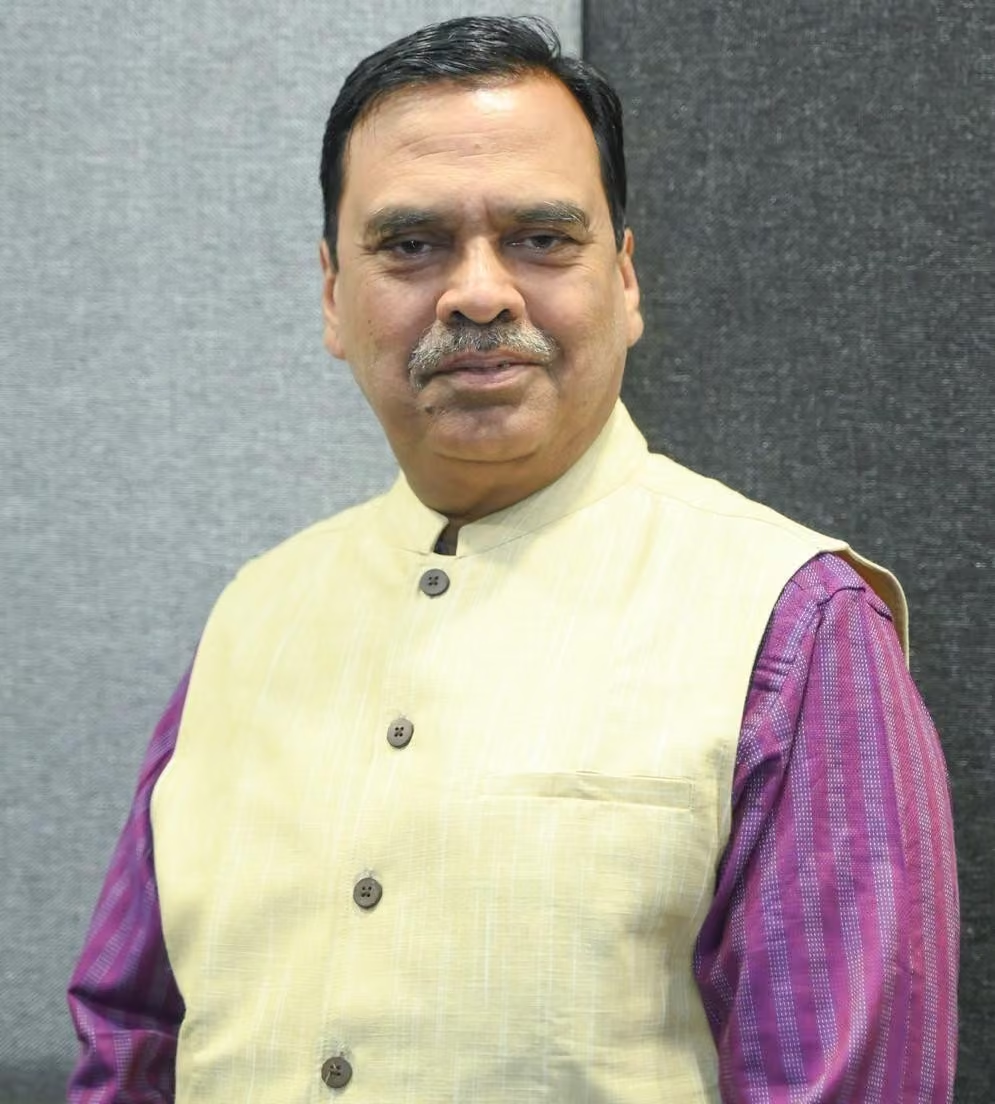
Dr S. K. Deshpande
Cardiac Anaesthesiologist, Nagpur
Introduction: The Birth of a Speciality
Modern anaesthesia began on 16 October 1846, when William T. G. Morton demonstrated ether anaesthesia. Over time, Anaesthesiology evolved from a supportive service into an independent discipline encompassing perioperative medicine, critical care, pain management, research, education, and healthcare leadership.
The Early Years: GMC Nagpur and IGGMC
Government Medical College (GMC), Nagpur, inaugurated by Dr Rajendra Prasad on 27 March 1947, commenced anaesthesia services in 1948 under the Department of Surgery. Dr M. S. Dubey was among its earliest qualified anaesthetists. The Diploma in Anaesthesia (DA) programme began in 1962, followed by the establishment of an independent Department of Anaesthesia in 1965, with Dr Dubey as its first Head. The MD programme commenced in 1972, strengthening postgraduate education. The late Prof. Dr R. K. Pradhan succeeded Dr Dubey in 1973, followed by Prof. Dr H. J. Mankeshwar in 1983.
At Indira Gandhi Government Medical College (IGGMC), the late Prof. Dr A. A. Ghosh established the Department of Anaesthesia around 1967–68. Both the Diploma and MD programs further strengthened specialist training and healthcare delivery in central India.
ISA Nagpur City Branch: Building Professional Excellence
Established in 1973 under Founder President Dr R. K. Pradhan and Founder Secretary Dr H. J. Mankeshwar, the Indian Society of Anaesthesiologists Nagpur City Branch (ISA NCB) has grown from ten founding members to over 450 life members. Its major milestones include its Silver Jubilee in 1998, the inauguration of its first office in 1999, and the successful organisation of the 48th National ISA Conference at GMC Nagpur in December 2000. Nagpur has hosted several significant scientific conferences till date.
Private Practice and Technological Transformation
The early private practitioners included Dr N. T. Balankhe, Dr Mrs Pandit, Dr Vinay Waikar, Dr Mrs Iyer, Dr Diyewar, and Dr Apte. In 1975, Dr S. A. Shrirao became Nagpur’s first MD-qualified anaesthesiologist to enter private practice, advocating for professional recognition, fair remuneration, and organised practice through the Association of Private Anaesthesiologists of Nagpur (APAN)
Early anaesthesia involved limited equipment, ether and trilene, basic ventilation, and monitoring that largely depended on clinical observation. The subsequent introduction of Halothane, Propofol, modern muscle relaxants, pulse oximetry, capnography, mechanical ventilators, advanced airway devices, and ultrasound-guided regional anaesthesia transformed patient safety and clinical practice.
Super-specialities, Critical Care, and Pain Medicine
The expansion of complex surgical procedures created new opportunities for specialised anaesthesia practice. Closed mitral valvotomy was first performed by Dr Kalke at IGGMC in 1970 and subsequently by Dr R. N. Das at GMC Nagpur after 1980. Neurosurgery, closed-heart surgery, and paediatric surgery also developed in the private sector during this period. Dr Shrirao, Dr Arvind Joshi, Dr Anil Jain, and Dr Rajurkar were closely associated with the development of these services. Dr Hemant Sane and Dr Vilas Tambe were among Nagpur’s early qualified cardiothoracic and neuroanaesthesia specialists. In September 1985, first open-heart surgery in Central India was performed with Dr S. K. Deshpande, a qualified cardiothoracic and neuroanaesthesiologist, as a member of this pioneering team. Kidney transplantation began in Nagpur around 1995–2000.
Thereafter, specialised surgical services expanded rapidly across disciplines. Today, complex procedures, including robotic surgeries, are routinely undertaken at GMC Nagpur and in the private sector. These advances would not have been possible without the growing expertise of anaesthesiologists in managing complex physiology, sophisticated monitoring, advanced ventilation, and the perioperative needs of high-risk patients.
- Critical Care: This field expanded through the significant contributions of Dr Arif Husain and Dr Vilas Tambe, among others.
- Pain Medicine: This discipline developed under pioneers including Prof. Dr H. J. Mankeshwar and Dr S. A. Shrirao. Later, specialists like Dr Anjali Kolhe, Dr C. S. Cham, Dr Lawange, and many younger professionals advanced the discipline through clinical work and specialised training. The establishment of the Indian Society for the Study of Pain on 9 April 1984 was an important national milestone. Historical accounts credit Dr H. J. Mankeshwar as Founder President and Dr Shrirao as Founder Secretary in developing the pain speciality in Nagpur.
Postdoctoral training and fellowships in cardiac, neuro, paediatric, obstetric, transplant, critical care anaesthesia and Interventional pain management further strengthened the speciality.
Public Awareness and Healthcare Leadership
Anaesthesiologists extended their responsibilities beyond operating theaters through public education and resuscitation training. Early awareness programs were conducted by Dr Mashankar and Dr Pratibha Deshmukh in 1993. Subsequent initiatives led by Dr Ranjana Deshmukh and Dr Sheetal Dalal promoted anaesthesia awareness and basic life-support training, which included the distribution of 75 AMBU bags.
Anaesthesiologists also emerged as hospital founders, entrepreneurs, educators, and administrators. Among those establishing hospitals and clinical facilities were Dr Arif Husain, Dr Anil Chande, Dr Anil Jain, Dr Deepak Anjankar, Dr Vilas Tambe, and Dr Khot. The late Dr Shirolkar served as Dean of Sir J. J. Hospital, Mumbai, while Prof. Dr H. J. Mankeshwar became Dean of GMC Nagpur in 1995.
Conclusion: From Silent Guardians to Perioperative Leaders
The evolution of anaesthesiology in Nagpur reflects generations of dedication, innovation, and academic commitment. From rudimentary equipment and limited monitoring to robotic surgery, advanced monitoring, and precision-based perioperative care, the speciality has undergone a remarkable transformation. Today, anaesthesiologists are indispensable perioperative physicians, critical care specialists, pain-management experts, educators, researchers, and healthcare leaders. The legacy established by Nagpur’s pioneers continues through the ISA NCB and successive generations committed to excellence, patient safety, and professional advancement.
Acknowledgements: Sincere gratitude to Dr H. J. Mankeshwar, Dr S. A. Shrirao, Dr Pratibha Deshmukh, Dr Anjali Kolhe, Dr Kiran Vyawahare, Dr Sheetal Dalal, and all colleagues who contributed valuable memories and information to this historical account.
Note: Some dates and details may require further verification.
With gratitude to the pioneers, respect for the present generation, and best wishes for the future of anaesthesiology.